Showing posts with label alicia cole. Show all posts

Saturday, July 4, 2009

Consumer Reports Profiles Survivor Alicia Cole

Reform should make it easy to get information on quality
August 2009

'I lay in my hospital bed watching my stomach turn black and purple and rot. It looked as if I had been snapped in half by a shark.'— Alicia Cole, 46, of Sherman Oaks, Calif.Photo by Melanie Eve Barocas

This article is the archived version of a report that appeared in the August 2009 Consumer Reports magazine.

When Alicia Cole learned she needed surgery for benign fibroids, she did her homework on the surgeon and the hospital. "I looked at HealthGrades, Leapfrog, Hospital Compare, and other Web sites," says Cole, a 46-year-old actress from Sherman Oaks, Calif. "But one thing I didn't check was the hospital's infection rate."

Even if she had tried to check, California hospitals didn't have to make such data public, and hers didn't. Cole had the operation there anyway. During her hospital stay, she came down with a post-surgical flesh-eating infection that turned her entire midsection into something worthy of a horror movie. After two months in the hospital and two years of painful rehabilitation, she still can't work. "The skin and scar tissue is so delicate that the least pressure will tear or scratch it," she says. Federal inspectors subsequently found unsterile conditions in the hospital's operating area.

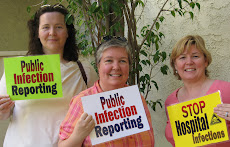
Enraged by her experience, Cole joined the fight against hospital infections and helped persuade the California legislature to pass a law requiring public reporting; she now sits on the advisory board for the law. Did she ever learn the hospital's infection rate? Sadly, no. The law has not yet been implemented. "What we really need is a national law," Cole says, noting that hospital-acquired infections are a leading cause of death in this country. "It's the elephant in the room," she says.

CU recommends

Health reform should make it simple to get good information on health-care quality. You should be able to find data not only on infection rates, a reform we've backed for years, but also on doctors, drugs, treatments, and errors. Yet most states still allow doctors to shield a history of malpractice settlements. And infection rates, if reported at all, are often kept secret, which doesn't provide enough incentive for improvement.

What does work is disclosure. Pennsylvania, which passed the first statewide reporting law, remains the only state to require disclosure of all major types of hospital infections. And infections there have dropped 8 percent in the last two years.

Read about our latest reform efforts and our analysis of legislation as its being debated in Washington, D.C. in our Guide to Health-Care Reform.

Friday, August 15, 2008

How to stop Hospital Infections

Fox11 News in Los Angeles reports on the very disturbing trend of more and more patients picking up stubborn, dangerous infections while in the hospital. Such was the case with necrotizing fasciitis Survivor Alicia Cole. Now Dr. Alfonso Torres Cook is fighting back against infections using a common-sense plan of attack, and drugs have nothing to do with it. More hospitals should follow his lead.

Wednesday, May 7, 2008

A Patient's Point of View

Actress Raises Awareness of Hospital Acquired Infections
By Megan M. Krischke, contributor

When Alicia Cole, whose only experience with hospitals was playing the role of a nurse on the popular TV show, Beverly Hills 90210, entered the hospital on August 15, 2006, for a routine abdominal surgery, she was expecting a two-day stay and was, by her description, “as healthy as a horse.”

(Actress Alicia Cole poses with her parents shortly before her release from the hospital, where she contracted a life-threatening infection.)

But, it would be two months before Cole was able to leave the hospital and, even then, she was greatly debilitated and faced a long road to recovery.

Soon after her surgery Cole contracted Necrotizing Fasciitis (NF), also known as Man-Eating Flesh Disease, which is as bad as it sounds. NF is an infection, often hospital acquired, that causes rapid destruction of soft tissue and muscle. The condition is rare and deadly, with a reported mortality rate of 70 to 80 percent.

During the most acute phase of the disease, despite aggressive treatment, Cole’s condition was so fragile that her life was in jeopardy for several weeks. She promised herself that if she left the hospital alive she would make it her personal mission to increase awareness among both medical professionals and the public about hospital-acquired infections.

A year and a half has passed since she first entered the hospital and Cole is still recovering from the wounds caused by NF and the six surgeries that were required to stop its spread throughout her body.

Cole has created several Web sites, including a MySpace.com page that tell her story and assist with networking and sharing information. She has also met with California Governor Arnold Schwarzenegger’s Committee on Hospital Associated Infections to push for awareness and safeguards.

“I also try to help my fellow NF survivors by counseling with them. We help each other mentally and emotionally,” said Cole, a 15-year member of the Screen Actors Guild who co-starred on General Hospital and The Young and the Restless, and appeared on many prime time shows, including Veronica Mars and Beverly Hills 90210.

“It is a difficult adjustment to have your life completely altered in an instant and to realize your health will never be the same,” said Cole, who has had to put her acting career completely on hold. “There is a close fellowship among survivors. Family and friends can be a huge support, but no one besides a fellow survivor truly knows what you are going through.

“My wounds were so massive that about a third of my body was affected. It has been the longest, longest process; it is a very surreal experience,” Cole said of her illness. “I’ve always been an athlete and I’ve never gone this long without exercising. I try to keep my spirits up because it can be depressing.”

Cole doesn’t condemn the medical profession but feels there is always room for improvement and that in-service education is a must to reinforce skills and introduce cutting edge treatments for NF.

In her effort to increase awareness about hospital acquired infections and to lessen their occurrence, there are several areas Cole would like to see hospitals address:

Sanitation and hygiene

“Just like in every other job, nurses get busy and start to cut corners. Sanitation simply isn’t a corner you can cut if you work in the medical field,” said Cole.

Often this is just a matter of following standard procedures, such as always washing hands before working with a patient. Cole would also recommend nurses keep long hair tied back, fingernails short, and because she was so sensitive to odors during her illness, she thinks nurses should forgo perfume while at work.

Teamwork

Cole would like to see medical staff, patients and caregivers work more as a team and for everyone’s input and opinion to be valued. Cole’s mother was the first to find the telltale sign of NF, a black dot, near her daughter’s incision. The nurse on duty passed if off as nothing, but Cole’s mother insisted on calling in the doctor—a decision that saved Cole’s life.

“Whistle Blower” Protection

“I think it is extremely important that nurses be able to report things and answer patients’ questions without fear of reprisal,” Cole commented. “There were several instances in my case where nurses gave us valuable information, but prefaced it by saying, ‘Please don’t say anything because I could lose my job.’"

Wound Care

“Outside of wound care centers, it seems that many doctors and nurses aren’t informed on the advances in wound care,” Cole said. “They send you home with basic wet to dry dressings when there are so many more advanced healing techniques and so many medications that promote healing and regranulation of tissue,” Cole said. “I think a lot of secondary infections, bed sores and breakdown of wounds and skin tissue could be prevented or better treated if doctors and nurses were kept up-to-date on the latest innovations in wound care.”

Finally, Cole wants nurses to know that patients appreciate them.

“Sometimes patients are in pain and not getting good sleep. It may not always sound like we are happy to see you. And it is true, when I see you coming with a needle, I’m not happy to see you, but I appreciate the care you are giving me,” Cole explained.

© 2008. AMN Healthcare, Inc. All Rights Reserved